
So, is AI stealing our jobs?
By Samyukta Pai
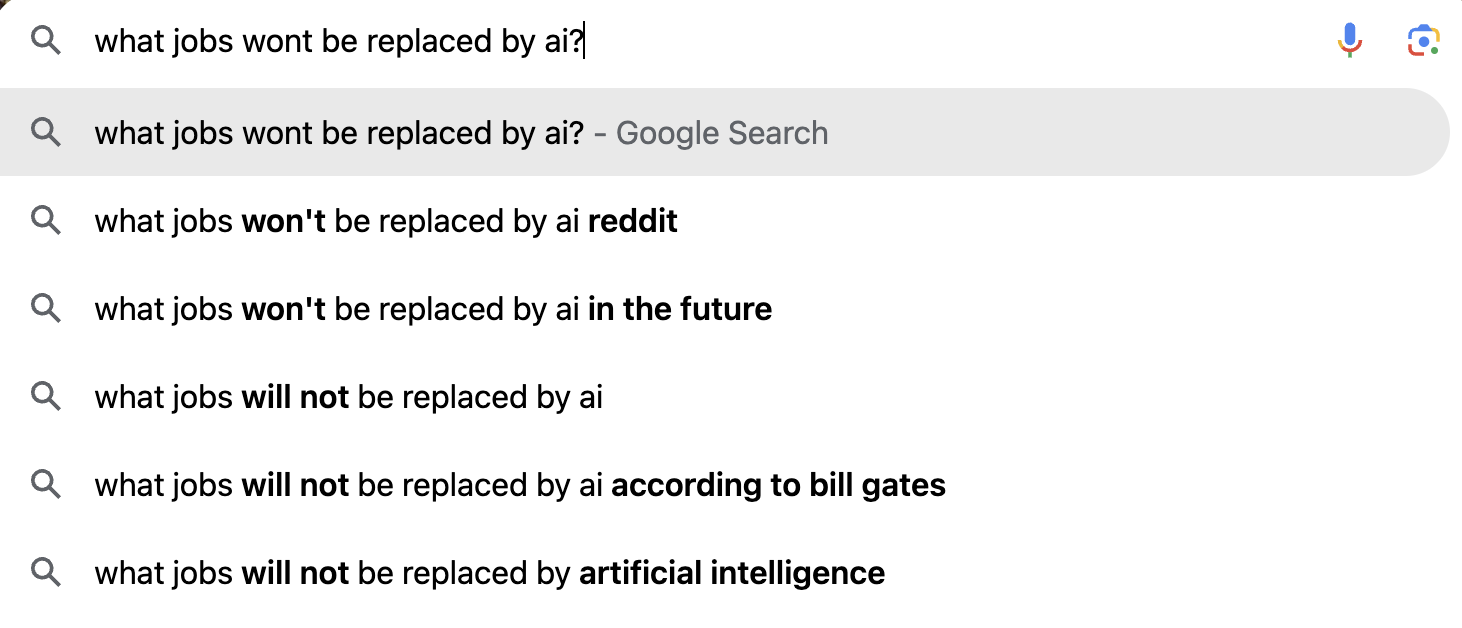
Scrolling through job boards these days feels more like reading tech forecasts than career options. Everywhere you look, there’s a splashy headline: “AI Will Transform 26% of Jobs!” or “Your Job Might Be Automated by 2027!”. Usually accompanied by a glossy photo of a robot shaking hands with a suit-wearing executive. It’s dramatic. It’s without-a-doubt eye catching, but is it… economically useful?
Well, maybe – but only if we look beneath the surface.
Let’s start with the basics: according to Indeed and the Pew Research Center, about 1 in 4 jobs could be “radically transformed” by generative AI (gen AI), especially in white-collar industries like tech, finance, and content creation. These are jobs that rely on cognitive skills, not physical labor – think coders, data analysts, tax preparers. The same AI tools that generate images of Pope Francis in a Balenciaga coat are now writing emails, summarising legal cases, and debugging Python scripts.
At first glance, this seems like a white-collar apocalypse. But take a closer look.
If anything, AI isn’t replacing workers en masse – it’s quietly replacing tasks, especially the boring ones. Scheduling, summarising, filling forms, and combing spreadsheets: these are time-intensive, low-value tasks that eat up hours but don’t define a job. Now they can be done in seconds by an algorithm. So yes, the job changes – but not always in a bad way. In many cases, the term “automation” is essentially just a form of delegation.
But here’s where it gets interesting – and mildly worrying.
The workers most affected aren’t in traditional low-skill roles. They're in college-educated, professional sectors. These are people who, for decades, were told: “Work hard, get a degree, and you’ll be safe.” Now, they’re the first ones seeing their job descriptions blur. AI writes faster than them. AI answers customer queries 24/7. AI drafts proposals in one click.
That’s not a robot taking your job. That’s your value proposition being quietly undercut – and with it, your bargaining power.
From a labour economics standpoint, this isn’t a new story. When machines took over physical labour in factories, jobs didn’t vanish overnight – they changed shape. Some disappeared. Others got better. Many became more precarious. And the profits? They flowed upward – to the owners of capital, not the hands that once did the work.
AI is simply doing the same thing – but for brains, not brawn.
And while many economists (especially in think tanks far from working-class reality) argue that displaced workers will “reskill,” we should pause. The assumption that a 50-year-old insurance adjuster will become a data scientist or prompt engineer overnight is, frankly, utopian. Reskilling isn’t free. It isn’t instant. And for many, it isn’t realistic.
Let’s also talk market structure. AI tools are built on data and compute power – things only a handful of companies currently own. That’s not competition. That’s concentration. And as these firms automate more services, smaller players can’t keep up, further shrinking options and funnelling power toward the centre.
This isn’t just a labour issue – it’s a structural one.
Yet media coverage often frames AI in moral panic terms: “Will AI replace your job?” or “How to AI-proof your career.” Rarely do we hear the real questions:
Who owns the productivity gains AI enables?
Why is cost-cutting always prioritised over human flourishing?
Should the benefits of automation be shared – or sold?
More importantly, if AI can generate vast economic value with fewer people, what happens to the people who are displaced? If our jobs don’t define our income, do we rethink what income itself means? Universal Basic Income? AI dividends? Collective bargaining with algorithms?
Too often, these ideas are dismissed as “radical” – yet it’s not radical to ask how technology that reshapes the economy should be governed. It’s only radical because the current system wasn’t designed for it.
So no, AI probably won’t take your job tomorrow. But it will take some of what made your job secure, valuable, and meaningful – unless we act. That means regulation. That means public ownership of key tech infrastructure. That means education systems are built for lifelong, not one-time learning.
The real disruption isn’t that AI is here; it's that it's here. It’s that we haven’t decided who gets to shape the future it creates.
Until then, the economy might run faster – but not necessarily better.
