
Are China’s Falling Prices a Problem or Just an Inconvenient Story?
By Elias Brixen

While on a regular scroll on social media, I came across this video that discussed China’s current economic situation, where prices were falling at an alarming rate, by the economics-focused magazine aptly named “The Economist.” Now, the Economist is seen to be a rather reputable news outlet. After all, its anonymous nature (where authors of articles are never cited) allows it to fulfill its editorial goals of being independent of political influences, objective and topical; yet, the longer this video progressed, the more flawed it seemed to be. It is naïve to assume that any news outlet does not have some form of inherent bias, and The Economist is no different—not really surprising, considering its status as a mainly Western journal targeting Western audiences. However, it was its economic evidence used, evidence which the Economist prides itself on being able to analyse, when backing up its claims, that caught my attention and raised concern.
The video opens with the phrase that China is facing a problem that other countries could only dream of: prices are “too low.” Why is this, according to our source? Well, it’s because of a phenomenon known as “involution,” or “a cessation of development or progress involving intense inner competition,” according to Wikitionary (and a definition which, might I add, took me far too long to find. Seems as though it's a rather niche concept…). Judging from what else is being said in the source (from companies being forced to cut down prices as they compete with each other to get even tiny amounts of market share, which “forces everyone else to do the same”) it seems as though China is currently experiencing a problem that goes “beyond regular market competition” and is faced with the apocalyptic inevitable doom of…perfect competition.
Likely, the amount of competition going on with firms fiercely cutting prices to gain market share and profits “plummeting” suggests that China’s economy is approaching (not necessarily at) perfect competition, as illustrated in Figure 1.
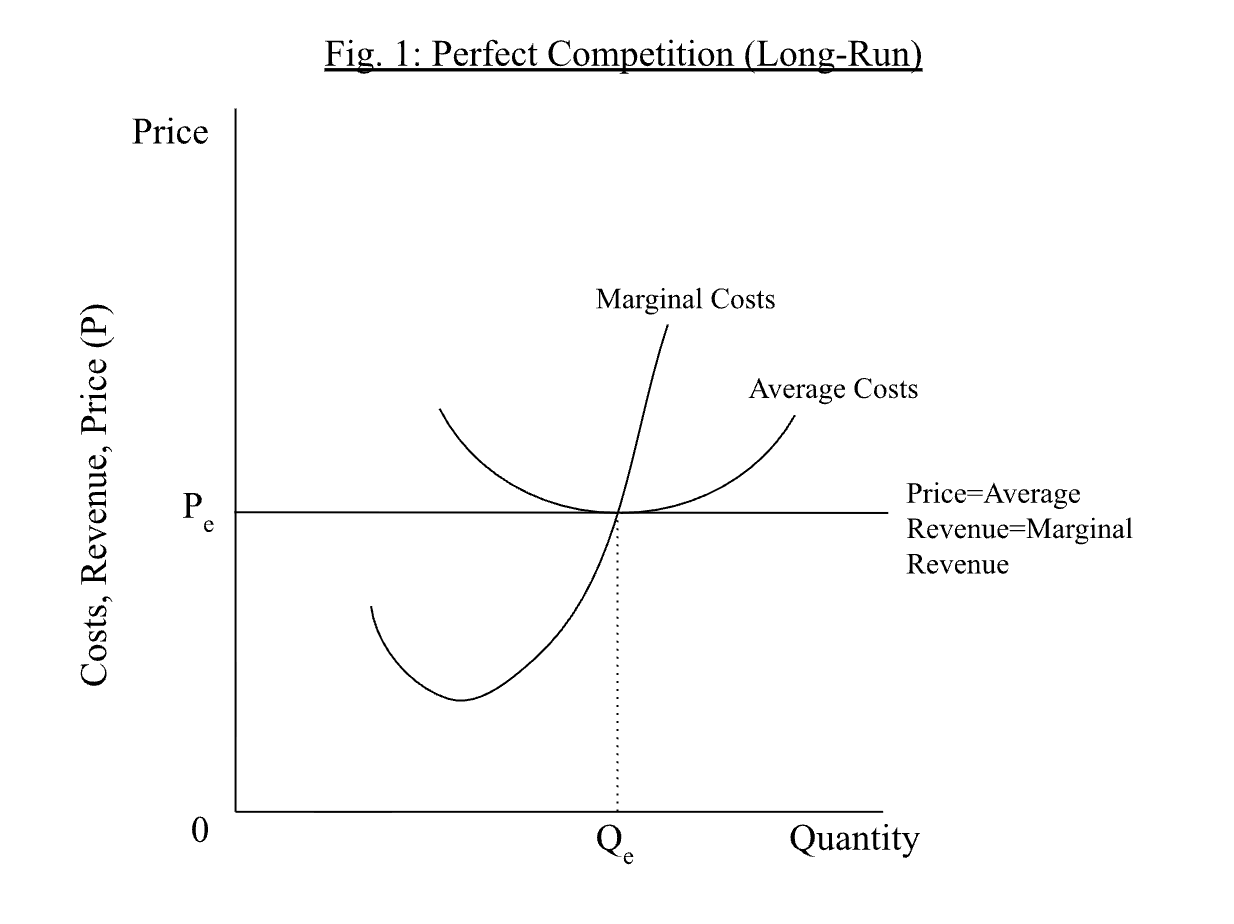
Perfect competition has three main characteristics:
There are a very large number of firms in the industry (check, whether that be for Solar Panels or EVs)
All firms sell homogeneous products (check, solar panels are indeed very similar to each other)
There are no barriers to entry (half-check…there are some, but with the scale at which prices across industries are falling, it is likely that some fit this criterion.)
Essentially, as the number of firms in China grows and everyone’s efficiency improves (since each tries to one-up the other by cutting prices), it becomes impractical, as “profits have [already] plummeted,” for firms to cut down prices even further. If any one firm charges above the price of the equilibrium, Pe, its customers are likely to substitute their purchases by buying from other firms.
What does this mean for us as consumers? Well, we turn to Figure 2 to examine this:
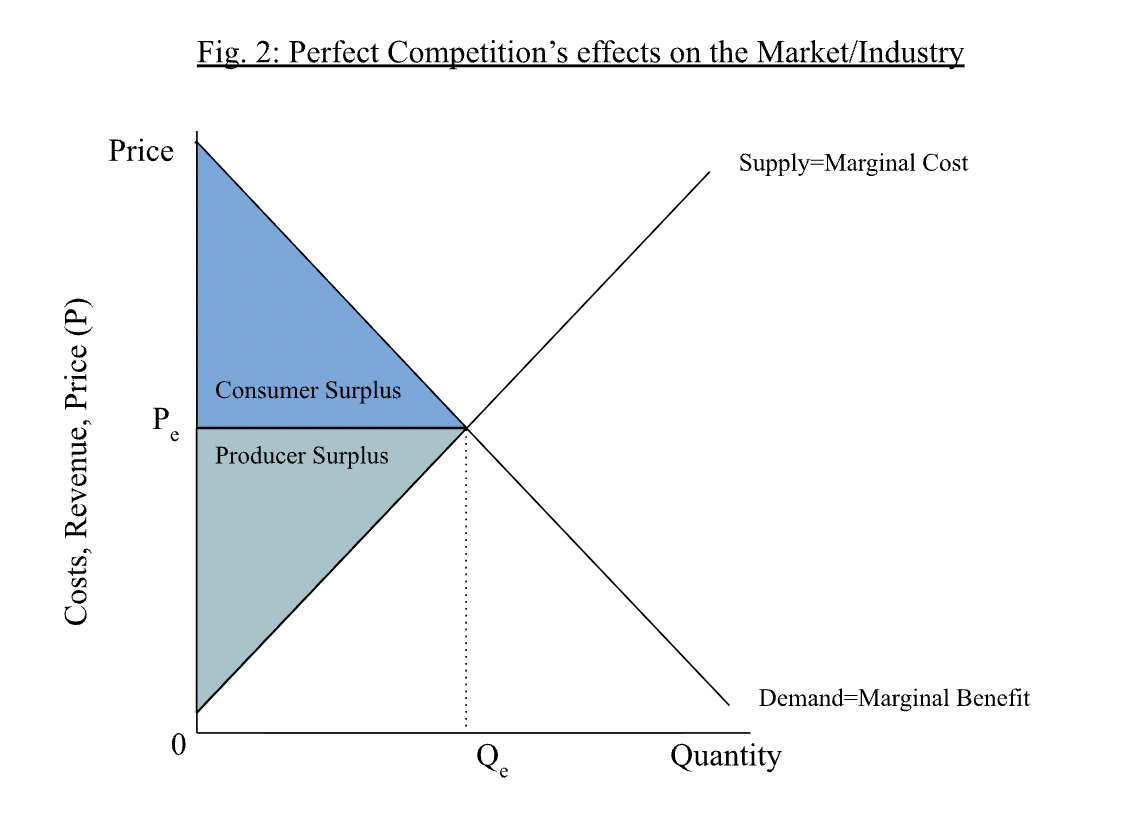
And, just as the video implies, we benefit from the optimal consumer surplus and social surplus. Prices are settled at the equilibrium level (Pe), and the quantity supplied is also at the social optimum (Qe).
Overall, both theory and intuition seem to suggest that what China is going through is positive!
And yet, the melancholic score accompanied by monochrome visuals paints a different picture—one which suggests that this is undesirable and one which presents a gloomy setting for China’s current economy. We’re presented with a visual of solar panels falling off a conveyor belt and piling up, meant to represent their oversupply in the current market; do we not also realise that as demand for green technologies increases, the demand for green energy production, especially of those that are efficient and, in the words of the Economist themselves, “world-leading” would increase? China can export these clean, cost-effective electricity-producing technologies to developing countries where they can be installed for domestic usage, increasing energy security, infrastructure, and providing additional knock-on positive effects throughout the entire economy, WHILE using renewable sources and keeping costs low! The BBC even reported a news story of new Nigerian firms being able to install local house solar panels at cheap costs, thanks to imports from China. Is that not what we want? This aligns perfectly with our SDGs, focused on sustainable and clean growth, right? Well, yes! But the problem most media have is a mainly political one, not economic. And yet, when we are presented with plausible economic theories, we risk being lost in the evidence rather than in the way it is portrayed or in what it actually means.
Take, for example, the very next segment, which argues that “households should think twice before being too happy about cheap prices,” regarding the prevalence of steep discounts all beneficial to consumers. A key point is that as profits decline, wage growth has stalled, as seen in Figure 3.
Fig. 3 Wage growth (%) vs. Year
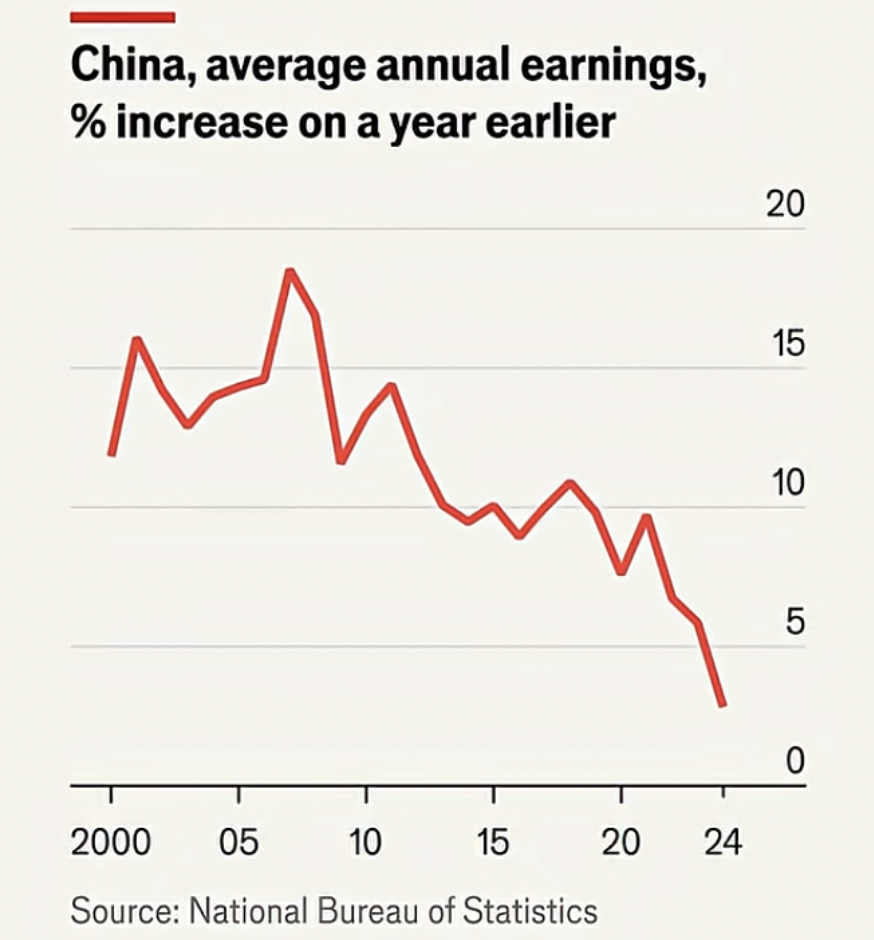
However, without considering contextual knowledge of what has happened or is currently happening in the Chinese economy, this graph is worse than useless; it is misleading, and I would argue intentionally slow. China’s growth was at an all-time high after a period of reform to a more capitalistic market structure following the 1990s, growth which continued well into the 2000s (and growth which is mirrored by wage growth in the graph), so of course, the numbers are bound to be ridiculously high.
I mean, could you imagine a 15% increase in your wages every year? Never mind that, it is also unreasonable to expect that such wage growth at such a level in the 2000s would continue.

I mean, Shanghai went from this…
Shanghai, 1996 (Source)
To this…
Shanghai, 2017 (same source as above).
What’s next? Utopia? China’s economic growth is nothing short of outstanding. Within 30 years, from 1990 to 2020, the percentage of China’s population living in extreme poverty went from around 70% to practically zero. The fundamental problem with percentages is that they are relative. An increase from 1 to 3 is 300%! Whereas an increase from 1000 to 1200 is a measly 20% (despite the absolute increase being much, much larger than the former). Of course the percentage in wage growth has fallen—it's much harder to increase the national average wages of 1 billion people now that people are living well than when people struggled financially every single day! On a similar note, you can see that while wage growth has fallen, the absolute value of wages has not; in fact, we can see this through the graph itself. Every wage growth value is positive! The Chinese are always earning more money every year, if only at a bit slower rate than in years prior. Data is a powerful tool, and if used and presented well, can cement your argument into a firm and solid position—yet, their misrepresentation, especially by authority, can skew its usefulness.
China is the second most populous country in the world, and has become a highly educated society as well. It is unlikely that Chinese policymakers are unaware of what China is currently going through—evidently so, they solved this same involution problem a decade ago, something which this video explicitly mentioned as well! And, benefits cited were…increased profit margins? Profits, which likely come at the expense of decreased consumer surplus. Abnormal profits are seen as desirable—normal profits are not.
In conclusion, who does this video target? Clearly not the Chinese audience, but likely us as Western, likely amateur, economists. The lesson here is that we must not be careful or inherently distrustful of authority, but that we should recognise that there is an inherent bias and think critically about what we consider to be economic success. Paradoxically, one of the beauties of economic sciences is the ability to passionately disagree on the merits of different theories in relation to the same topic, even among experts. Between Keynesian policies, neo-liberal economics, and a cornucopia of other views and theories (it's no wonder that literal centuries of books have been written debating and reconciling with the different perspectives), it is ultimately up to you as an economist to decide what you consider a successful economy ought to be. In the meantime, think and engage critically with your news sources—make your own judgements and ask yourself what data presented really means. You might find out that your ideas and arguments differ a bit more than originally assumed.
